Empire of Ink: Alex Wright (PhD ’22) on Newspapers, Systems, and the History of Information
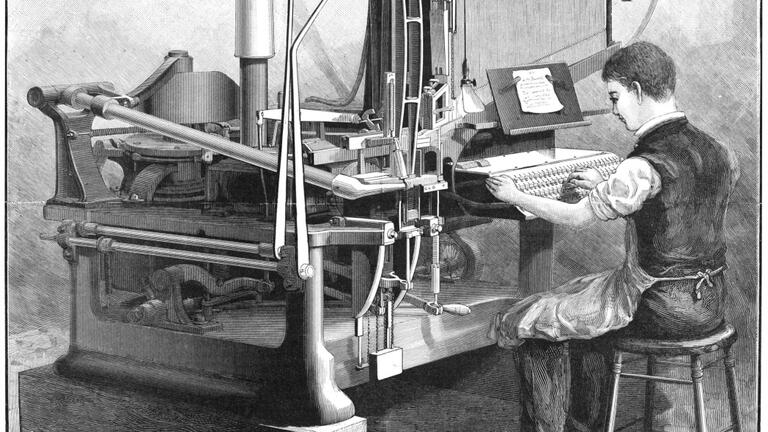
Illustration of the Linotype in use at the New York Tribune. Scientific American, vol. LX, no. 10, March 9, 1889, 143

From the Revolutionary era to the late nineteenth century, the number of newspapers in the United States rose from 37 to more than 20,000, an astonishing period of growth that Alex Wright (PhD ’22) describes as “essentially unprecedented in the history of printing and publishing.”
In his new book, Empire of Ink, Wright explores the early history of American newspapers and the people who made them. The book also examines some of the lesser-known characters and sociotechnical developments that reshaped the media landscape during this period.
For Wright, who recently stepped into a new role as Vice President of Product Design at Hearst after a stint at Google, the book grew in part out of a personal connection. He comes from a family of small-town newspaper people who published a series of country weekly papers in Georgia going back to the nineteenth century. Though he has spent most of his career in the technology sector, Wright has also been in and out of journalism himself over the years.
“I’ve always been interested in the history of information, and how new technologies and systems shape the way people think,” Wright said. While his previous books explored some of those questions during other historical eras, with Empire of Ink, he wanted to focus more narrowly on the history of news.
Humanizing the System
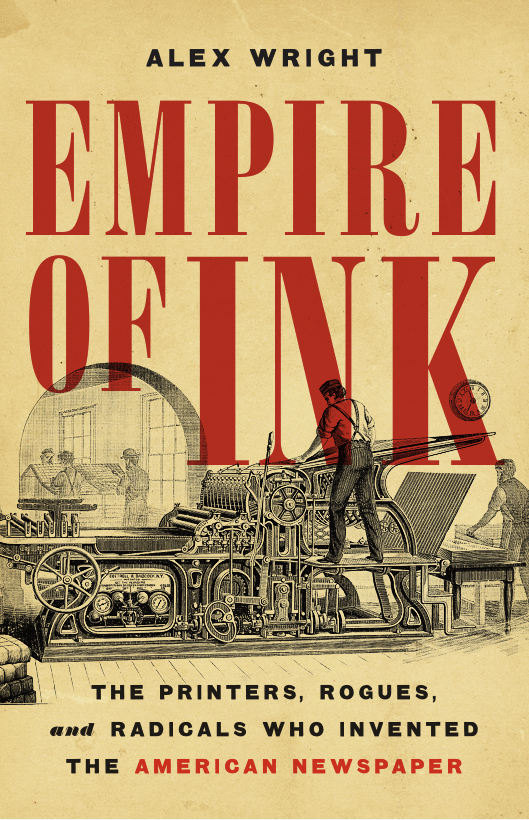
Wright has tried to center the book around the people who lived through this period, including many who have largely disappeared from conventional histories of journalism. Alongside better-known historical figures like Amelia Bloomer, Mark Twain, and Benjamin Franklin, the book introduces characters like 11-year-old “Little Nellie” Williams, who started her own weekly newspaper to support her family, and George “The Velocipede” Arensberg, the fastest typesetter in the nation, who became a minor celebrity in the 1870s.
“First of all, I hope they enjoy the stories,” Wright said. “While the book covers quite a bit of ground, I’ve really tried to center it around the people who lived through this period.”
Beyond the individual stories, Wright also hopes readers come away seeing the media landscape with fresh eyes.
“The newspaper wasn’t simply a container for journalism. It was a technology and a social system unto itself, one that people had to invent, often messily, over the course of generations. It was, in many ways, a living system.”
Wright is wary of drawing too many historical parallels between previous eras and the present day, but he believes history can give us a useful perspective on sociotechnical change. He points to a tendency to idealize the so-called “golden age” of newspapers, while most conventional histories of journalism focus primarily on the large urban newspapers of the late nineteenth and twentieth centuries.
The period that came before often receives scant attention. In Empire of Ink, Wright argues that the newspaper landscape of the early to mid-nineteenth century looks much more similar to the present day than what came after. For much of American history, the media were fragmented, partisan, and often spectacularly unreliable. In some ways, he argues, the relatively homogeneous, sober-minded mass-media ecosystem that many people grew up with was “the historical anomaly.”
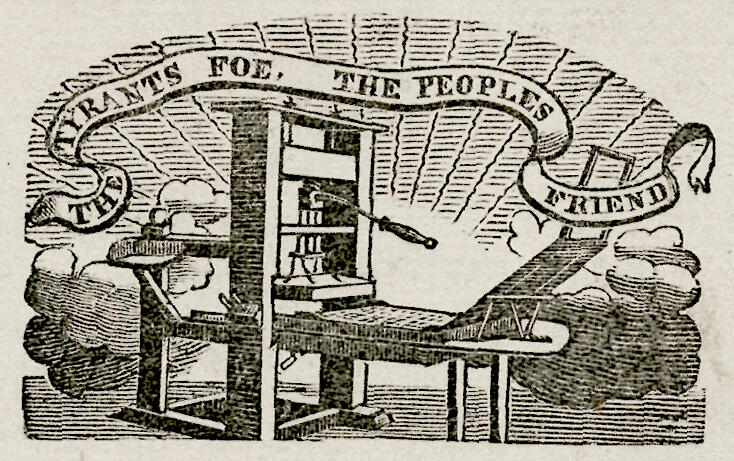
“History can cure us of the assumption that our present-day circumstances were somehow inevitable,” Wright said. “Americans have repeatedly had to figure out new norms and institutions when the technology and economics of information changed faster than society could keep up. We’re living through another one of those moments now.”
The CMU Connection: Design as a Lens
While Empire of Ink did not grow directly out of Wright’s doctoral research, he says his understanding of ecosystems was deeply informed by his work at Carnegie Mellon University’s School of Design. His dissertation focused on regenerative design frameworks for user experience designers working in industry and drew heavily on the Transition Design framework, which Wright says was instrumental in shaping his worldview of complex systems and how they interact.
“Ultimately, it circles some of the same territory: How do people interact with information? How do the structures and interfaces we create shape what people can understand? And what happens when a new technology changes the way information moves through a society?”
Wright says his CMU education still comes up in his day-to-day work, less through the application of a particular design methodology than through the way CMU taught him to think.
“One of the most important things I took away from the Transition Design PhD program was the notion of design being about more than just the production of artifacts. It’s a way of thinking, and of seeing the world through the lens of systems,” Wright said.
That perspective has been helpful throughout Wright’s professional life. He has worked on sellers' experiences at Etsy and developed digital news products at Google News. Today, his work at Hearst Newspapers is focused largely on trying to create a sustainable future for local news.
It has also shaped the way Wright approaches writing history. As he puts it, he tends to look at historical subjects partly as a designer would:
“What is the system? Who were the actors in that system? What were the points of inflection (or leverage points, as Donella Meadows would have called them)? And ultimately, what happens when a new technology arrives and suddenly enables entirely different kinds of human behavior?”
“So even though my day-to-day work has changed enormously since I left CMU, I still feel like I’m drawing on some of the same habits of mind that I developed there.”