Who Owns This Book? Michele Hratko Explores Copyright, Creativity, and Design Culture

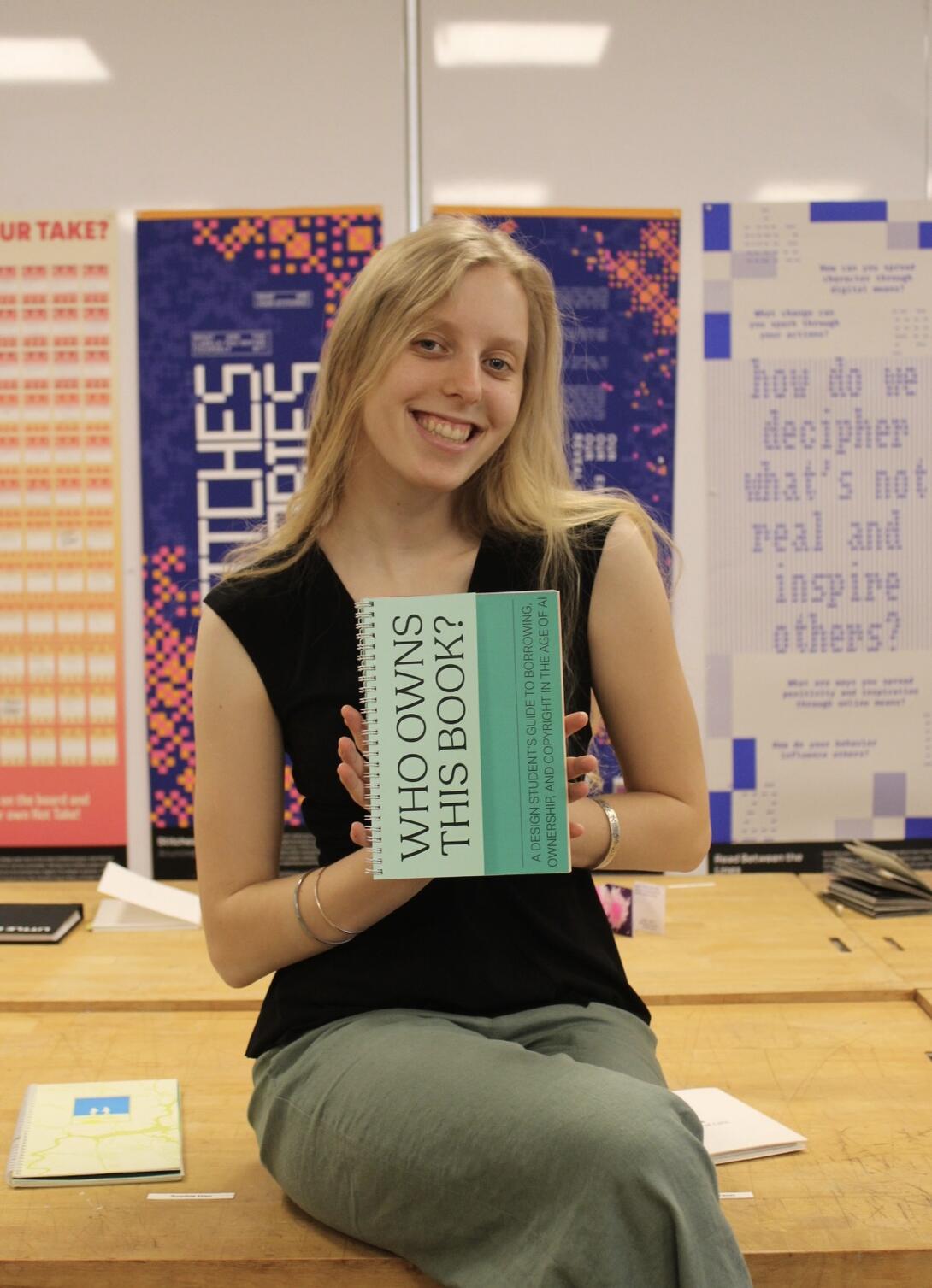
For junior Michele Hratko, a familiar question kept surfacing in studio conversations: who actually owns the images, typefaces, and references designers use every day?
That question became the foundation for her recent publication, Who Owns This Book?, a project that examines the often-overlooked complexities of copyright in design.
Created in Kristin Hughes’ communication design studio, the book began as an exploration of working with found material, like essays, images, and other visual references. But as Hratko listened to classmates grapple with questions about using online content, the project quickly took on a more focused purpose.
“My goal for Who Owns This Book? was to create something that could directly impact the community that would be interacting with it: my peers in the School of Design,” she says. “So ultimately my goal for this book was to respond directly to questions about ownership and copyright that I’ve heard floating around me throughout design school, while layering in ideas about libraries and archives and how we protect those shared sources of public domain or copyright-free information.”
For many design students, copyright can feel abstract or distant. Much of their work exists in an educational context, where fair use often applies and sourcing isn’t always closely examined. That changes quickly outside the classroom.
“I think copyright is complicated and under-explored for students because we have the fortune of fair use: for the most part everything we’re doing is educational. No one really asks or cares where our content or images come from,” Hratko explains. “It wasn’t until I did internships and created things that would be sold or released into the world that I had to start tracing back the images I was using to make sure they were available to be distributed.”
At the same time, she notes that borrowing—whether direct or indirect—is fundamental to how designers learn and develop their practice.
“We’re always looking at the internet for examples of ‘good design’ so we can understand how to design on our own,” she says. “I think that creates an interesting tension, because even if you’re not directly using someone else’s work, it gets easy to lose your own voice when you’re taking in so much visual information from the internet.”
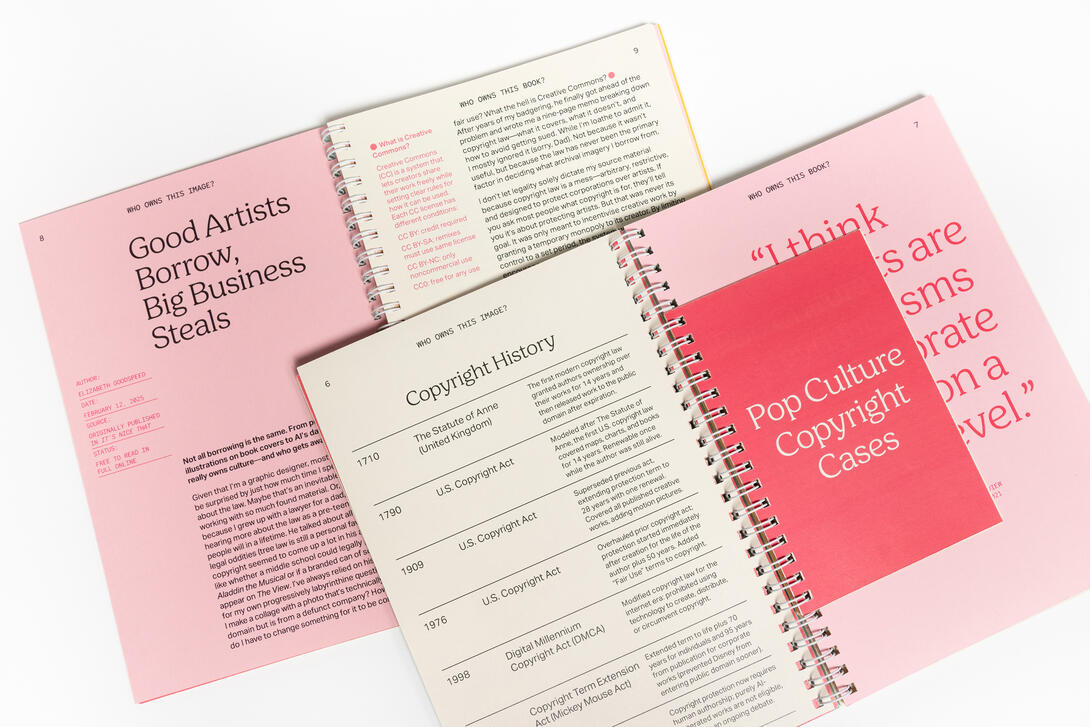
One of the most impactful insights in the book came from a conversation with designer and writer Elizabeth Goodspeed, who visited CMU as part of the Design Lecture Series. That exchange helped Hratko think more critically about how designers engage with source material.
“She explained that what differentiates using a public domain image from an AI-generated image for example, is the ability to trace the history and origins of the image to understand the context that it comes from,” Hratko says. “The origins of an AI-generated image are much more opaque.”
That idea of understanding where things come from extends beyond legal considerations into creative practice. For Hratko, archives became a central theme of the project, not just as sources of material, but as spaces of discovery and learning.
“I hope that this book inspires people to contribute to shared archives and support them, whether by uploading or downloading media from them,” she says. “Archives at your local library are also really cool places to explore physical media that few others have probably seen because it’s not scanned on Pinterest.”
The project also reflects the broader learning environment at the School of Design, where exposure to visiting designers and ongoing industry conversations helps shape student work.
“This project was sparked by a lecture from Elizabeth Goodspeed that I attended as part of the Design Lecture Series last year,” Hratko says. “I think keeping in touch with current conversations among designers is important, especially for students, to gain context on the industry that’s evolving around us.”
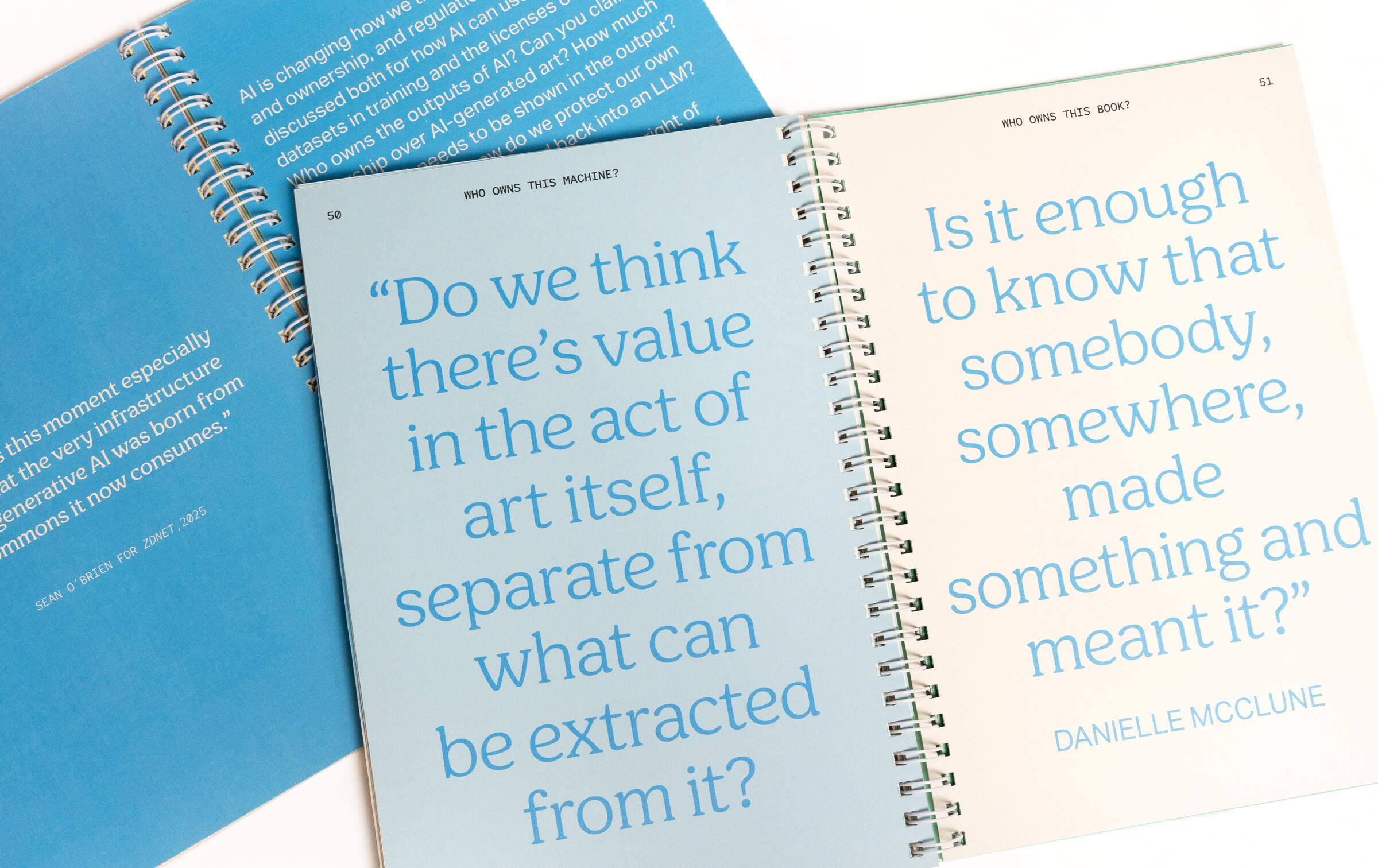
Visually, Who Owns This Book? is deliberately minimal, relying on typography and color as its primary elements. That approach highlights the importance of craft and clarity, skills Hratko has developed throughout her time in the program.
“My book is pretty minimal, using mostly type and color as the driving visual elements, so everything I’ve learned about type hierarchy and readability over the past three years was applied here in my first long-form publication,” she says.
Rather than offering definitive answers, Who Owns This Book? opens up an ongoing conversation, one that many emerging designers are only beginning to navigate.