Danny Linitz Wins the 2026 Pangaro Cybernetics Prize


Rising junior Danny Linitz has been awarded the 2026 Pangaro Cybernetics Prize for Outstanding Design Proposal, recognized for his proposal rethinking the design of at-home oral HIV testing systems through the lens of cybernetics and systems thinking.
Established in 2025 by cybernetics scholar and educator Paul Pangaro with support from School of Architecture Head Omar Khan, the Pangaro Cybernetics Prize honors student work that applies cybernetic principles to complex contemporary challenges. The award includes an unrestricted $5,000 prize and seeks to encourage students across Carnegie Mellon University to engage deeply with cybernetics as a framework for designing within complex social, technical, and environmental systems.
“Winning this prize was incredibly rewarding,” said Linitz. “I put a huge amount of time and effort into my submission this semester to make something I’m proud of, so it felt great for my work to be recognized.”
Linitz’s proposal centers on the At-Home Oral HIV Test, a consumer medical product increasingly available in retail settings as an alternative to clinical testing. Inspired in part by the widespread familiarity of at-home COVID tests during the pandemic, Linitz became interested in the challenges of designing consumer-facing medical systems—particularly in contexts shaped by stigma, uncertainty, and public misunderstanding.
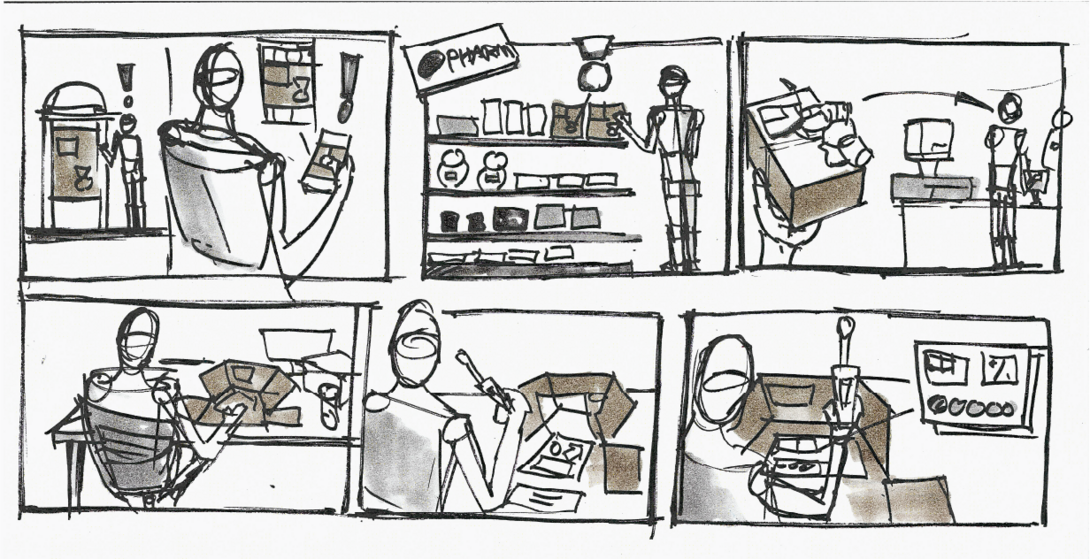
“The redesign exposed the difficulties in designing a consumer medical test, especially in a stigma-filled environment like that surrounding HIV,” Linitz explained. “I felt that Cybernetics was the perfect methodology to work with when designing a better Oral HIV test System because it is all about interrogating challenging systems, not just ‘solving problems’ in a linear sense.”
Cybernetics, though often associated in popular culture with robotics or artificial intelligence, is fundamentally concerned with how systems function through feedback, adaptation, and human participation. Pangaro describes it as a way of understanding systems through purpose and steering.
“Cybernetics looks at systems from the point of view of their purpose: what’s it for, what does it do?” Pangaro said. “It looks at how systems use information as feedback to achieve goals.”
PhD candidate in Transition Design Maria Yen describes cybernetics as “a quiet partner to design for decades,” even when it has not always been explicitly named. “The questions it asks — what is this system for and who is doing the steering — are questions designers have always been asking in their own vocabularies,” Yen said.
Yen emphasized that cybernetics contributes a shared framework for examining systems while also insisting that designers themselves are never neutral observers outside the systems they shape.
“That observer-included view, what is called second-order cybernetics, maps onto how contemporary design has come to think about reflexivity and responsibility,” Yen explained. “Cybernetics does not arrive at design as something foreign; it joins a conversation already underway, and the School of Design is one of the few places where that conversation can deepen.”
According to Pangaro, Linitz’s proposal stood out for both its intellectual rigor and clarity of communication.
“The proposal is so well-crafted, thought through, and articulated with clear concerns about the current situation in regard to HIV testing,” Pangaro said. “The jury appreciated the maturity of the proposal, which was very achievable and not exclusively reliant on any particular technology. Cybernetic methods were well integrated into defining and designing the project, and the overall documentation was coherent and persuasive.”
“The Pangaro Cybernetics Prize is an interdisciplinary award that recognizes the interconnectedness of knowledge and how we can ethically act in the world,” added Professor and Head of the School of Architecture Omar Khan. “Danny's project is an excellent reflection of the different modes of design necessary to address wicked challenges.”
Linitz believes the project’s strength came from its careful visual and written communication—an approach deeply shaped by his education at the School of Design.
“I think that my project stood out in the competition because of its clarity and visual communication,” he said. “I spent a great deal of time thinking through every map, sketch, and diagram I made for my submission so that the reader could properly understand the ideas I proposed.”

He credits foundational coursework in visual communication, systems thinking, and interdisciplinary study for helping him approach healthcare design challenges with both analytical depth and empathy.
“The School of Design’s focus on systems thinking was essential to my understanding for this project,” Linitz said. “We learn about system mapping in Design Studies and are exposed to ideas around ‘wicked’ challenges from Transition Design, which I grappled with in the proposal.”
Pangaro noted that the School of Design’s emphasis on systemic complexity and cross-disciplinary collaboration creates an environment where projects like Linitz’s can thrive.
“Cybernetics is an excellent complement to the tradition of Transition Design in SoD,” Pangaro said. “Together they create a fertile environment of discourse that can support designers who are passionate about increasing human agency in the face of the wicked challenges of the age.”
This year’s submissions to the Pangaro Cybernetics Prize spanned topics including neighborhood systems, healthcare, environmental justice, and the integration of generative AI into collaborative design processes, with entries from students across Architecture, Design, Information Systems, and the Tepper School of Business.