Groundswell Creates Space for the Soul: Co-Designing with Oncology Staff at UPMC Magee-Womens Hospital

When UPMC Magee-Womens Cancer Services Staff enter the oncology unit on October 3rd, 2025, they will be met with the anticipated launch of Groundswell - a multi-level design ecosystem that supports the well-being of oncology staff. What originated as a concept pitch in a graduate course at Carnegie Mellon University’s School of Design is transitioning to a twelve-month quality improvement research study. This careful evolution showcases what is possible to achieve through sustained relationships, cross-disciplinary co-design, and strategic stakeholder engagement.
For weeks, an illuminated floral installation quietly glowed on the 4th floor of UPMC Magee-Womens Hospital, catching the eyes of staff as they moved between departments. Carefully nestled in a space that once housed telephone booths, the Groundswell Pod invites all Cancer Services staff to take a moment to restore. That one moment can reinforce the message that emotional labor is tangible, visible, and shared across the care team.

Groundswell Pod and Artwall, Photo credit Kevin Lorenzi
With a poem on the wall next to the pod, passersby began encountering the heart of Groundswell, an acknowledgment that healthcare workers’ well-being is essential to patient-centered care.
Excerpt from the installation poem:
Remember your heart.
Remember how it has expanded beyond its borders,
how it has learned to hold both joy and sorrow without breaking.
Remember the grief that lives in your body.
Not as weakness, but as testament to your immense capacity
to care beyond reason, to love beyond caution.
Remember that a current flows between you and your colleagues—
an understanding deeper than words.
We come together like water through soil, a groundswell of quiet strength gathering force.
For what you carry, we all carry.
Interconnected dimensions of care
Named for water that rises naturally from deep within the earth, Groundswell emerges directly from the voices of healthcare workers themselves, while introducing resources that acknowledge the emotional complexities of oncology care.

Email Template
An updated patient death notification email template with compassionate visuals and language that acknowledge the impact of patient loss. While updating an email template may seem minor, it represents an approach to systemic change that is actionable, approachable, and has immediate impact.

An updated patient death notification email template with compassionate visuals and language that acknowledge the impact of patient loss. While updating an email template may seem minor, it represents an approach to systemic change that is actionable, approachable, and has immediate impact.
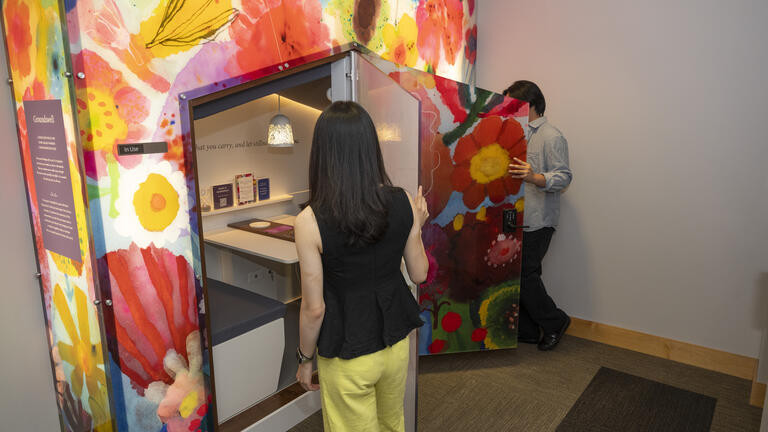
The Groundswell Pod
A restorative pod for emotional decompression through mindfulness activities. The pod was designed to integrate with the existing hospital architecture, eliminating the need for extensive renovation.

A restorative pod for emotional decompression through mindfulness activities. The pod was designed to integrate with the existing hospital architecture, eliminating the need for extensive renovation.

The Groundswell Pod
“This project emphasizes how, through considered design and collaboration, formerly underutilized areas of facilities can be energized to support the needs of healthcare workers,” said Greg Baltus of Hardware Assembly, who led the industrial design and fabrication of the pod. “Especially at older, evolving facilities, which may not have been designed to support staff mental health, these small interventions can have a positive impact on healthcare workers’ emotional wellbeing.” The pod’s artistic structure also contributes a warm and inviting aesthetic to what would tends to be a cold, clinical environment.

“This project emphasizes how, through considered design and collaboration, formerly underutilized areas of facilities can be energized to support the needs of healthcare workers,” said Greg Baltus of Hardware Assembly, who led the industrial design and fabrication of the pod. “Especially at older, evolving facilities, which may not have been designed to support staff mental health, these small interventions can have a positive impact on healthcare workers’ emotional wellbeing.” The pod’s artistic structure also contributes a warm and inviting aesthetic to what would tends to be a cold, clinical environment.

Guided Reflection
Guided reflection resources that integrate self-care practices and emotional regulation tools into daily rhythms. Reflection cards provide a tangible means of engaging with complex emotions, free from digital distractions.

Guided reflection resources that integrate self-care practices and emotional regulation tools into daily rhythms. Reflection cards provide a tangible means of engaging with complex emotions, free from digital distractions.

Guided Reflection
Those who prefer time-blocked experiences or audio interactions may use the digital platform to access custom guided meditations and calming instrumentals.

Those who prefer time-blocked experiences or audio interactions may use the digital platform to access custom guided meditations and calming instrumentals.

Community Art Wall
A community art wall that invites anonymous participation through shared expression, acknowledging the emotional labor of all care team members, from clinical staff to administration to family caregivers and patients.

A community art wall that invites anonymous participation through shared expression, acknowledging the emotional labor of all care team members, from clinical staff to administration to family caregivers and patients.



Design and Medicine in Conversation

This kind of innovation doesn’t happen by accident. It grows from relationships built on mutual respect and shared experiences. One such seed was planted in a conversation between Professor Kristin Hughes and Dr. Sarah Taylor, a compassionate leader in Gynecologic Oncology at UPMC. In that exchange, they discovered a common language, one rooted in empathy, curiosity, and care. They quickly recognized the potential synergies between design and medicine, as well as the possibilities that could emerge when the multiple disciplines work side by side.
Together, they initiated a collaboration to explore what might be possible when diverse cross-disciplinary teams work together. They gathered healthcare representatives who were already leading change within their departments to co-create the course “Designing with CARE: Co-Creating Solutions for Complex Care Coordination in Oncology.” The class emphasizes how design thinking can drive 'small wins' to improve patient care, reduce costs, enhance access to clear and reliable services for patients and their caregivers, and promote health equity. From the beginning, Dr. Taylor has consistently highlighted the importance of small wins. When ‘small wins’ are nurtured and amplified, they ripple outward, fostering collective ownership and creating the cultural shifts needed for lasting change. The Groundswell project is an excellent example of this thinking.
“Caring for people means seeing them as whole, complex, and beautiful human beings—not just as patients in need of medicine or surgery,” said Dr. Taylor. “In a world full of moving parts, design helps us navigate that complexity by blending empathy with practicality, creating solutions that speak to the physical, emotional, and psychological needs of both those receiving care and those providing it. Burnout in healthcare is widespread, and while wellness tips and tokens of appreciation are needed and valued, they’re not enough. Healthcare workers deserve deeper, sustained support."
“This work is about truly listening, understanding what nurtures their wellbeing, and designing systems that restore fulfillment and reduce burnout—because healing begins with caring for the caregivers.”
Measuring What Matters to Healthcare Workers
Groundswell’s viability as a quality improvement study, not just an installation, required integrating design methods with clinical research requirements. Dr. Grace Campbell co-led the survey design and distribution strategy, bringing expertise the design team lacked in institutional review processes and clinically meaningful measurement.
“Healthcare is increasingly stressful,” said Campbell. “This pilot project has been an excellent opportunity to merge design thinking with the very real concerns of healthcare professionals about burnout, emotional and physical overload, and grief. We’ve designed the project, the implementation plan, and our measures specifically to reflect staff concerns. We will also be interviewing staff to gather insights throughout the project about what’s working and what can be improved.”
Over the next 12 months, the study will track usage patterns, including anonymous contributions to the community art wall, engagement with guided meditations, pod utilization data, and ongoing conversations with staff about their experiences, ensuring both qualitative and quantitative insights inform further iterations.

Small reminder cards will be distributed and given to staff members, primarily from department leaders to their teams, to remind everyone that it’s okay and important to take a moment to pause and reset.
Learning Alongside and With
Designers working within healthcare systems must be prepared to have their assumptions and ideas redirected by the medical community and discipline-specific expertise. The Groundswell team experienced this iterative feedback at every stage, adapting designs based on staff input and institutional realities. “We thought we understood how certain systems would function,” explains Elijah Benzon (MA ’25), “but firewalls, competing software, and technological limitations made it clear there were constraints we hadn’t anticipated. Staff expertise at every stage helped us adapt, ensuring our designs could actually operate within the hospital environment.
These insights informed design decisions —from adjusting language to accommodating institutional technical limitations, to understanding what would motivate survey participation—things the team could not have predicted alone. Lorin Anderberg (MA ’25) reflects, “While designing within constraints like short timelines, small budgets, and institutional barriers challenged our ability to engage as deeply as we would have liked, it was pretty amazing to see how much we were able to accomplish while still centering and amplifying community needs. Because of the relationships built in years prior, our process was able to be guided by community wisdom at every phase.”
Cultivating the Conditions for Change
When design meets systems change and is rooted in relationships, outcomes become more than products but rather symbols of collaboration and seeds planted for better futures. Rather than siloing expertise, this type of co-creation allows collaborators to become peers and the network of design to expand beyond skillsets.
The School of Design’s partnership with UPMC continues to evolve through the pilot study and the upcoming spring course, now entering its third year. Samantha Williams, Director of Women's Cancer Services at UPMC, expresses gratitude for the collaboration. "We are especially grateful to Dr. Sarah Taylor, University of Pittsburgh, and Carnegie Mellon University School of Design, whose leadership and vision helped bring this initiative to life," said Williams.
Groundswell is already creating space for crucial conversations about workplace well-being.
"Groundswell reminds us that caring for patients begins with caring for the people who serve them,” added Williams. “By creating intentional spaces and practices that acknowledge the emotional realities of oncology care, we're laying the foundation for a culture where staff well-being is recognized as essential."
"Groundswell is not just a campaign—it's a commitment,” said Kendyl Grant, Director of Operations for the Gynecologic Oncology Division at UPMC. “By centering staff-identified well-being priorities, we're ensuring that every voice is heard and concerns are addressed. This initiative reflects our leadership's belief that sustainable change begins with listening to those who live the work every day."
The real work lies ahead and the team learns and adapts to how the community engages with this ecosystem, making sure it continues to meet the needs of those it was meant to support.
Groundswell is a collaboration between Carnegie Mellon University School of Design; the University of Pittsburgh Schools of Medicine and Nursing, and the Gynecologic Oncology staff at Magee. We are especially grateful to the Department of Obstetrics, Gynecology, and Reproductive Services and the incredible staff at Magee, who made this project possible. We also thank the College of Fine Arts at CMU; the UPMC Magee-Womens Hospital Medical Staff Fund; and the Paul D. Schurgot Foundation for their generous support
Groundswell would not exist without an extraordinary community of artisans and donors. The restorative pod was made possible by NookPod’s gift of the structure; Greg Baltus from Hardware Assembly’s remarkable design, engineering, and fabrication skills; and components from Schlage, Density, Dixie&Grace, Z9 Machinings, and EHC Industries. Ryan Thompson made the walnut tabletop from wood donated by Eleanor Mackie Pigma. Catherine Liggett voiced meditations. Generous donations from Deborah Linhart, Pamela Meadowcroft, and Marge Petruska enabled us to distribute a set of restorative cards to every employee participating in this study—special thanks to Mark Baskinger for creative support and encouragement.
To everyone who contributed, thank you.