Reimagining Human–AI Relationships: Diane Hu’s Work Earns Three Acceptances to CHI 2026

Current Master of Professional Studies (MPS) student Qing (Diane) Hu will present three papers at the 2026 ACM CHI Conference on Human Factors in Computing Systems (CHI), the premier international venue for research in human–computer interaction.
With one paper as first author and two additional collaborative works, Hu’s research spans workplace AI, collaborative systems, and the ethical design of large language models. Together, the projects explore a pressing question: how does AI reshape human relationships — at work, in teams, and in conversation itself?
When the Boss Is an AI
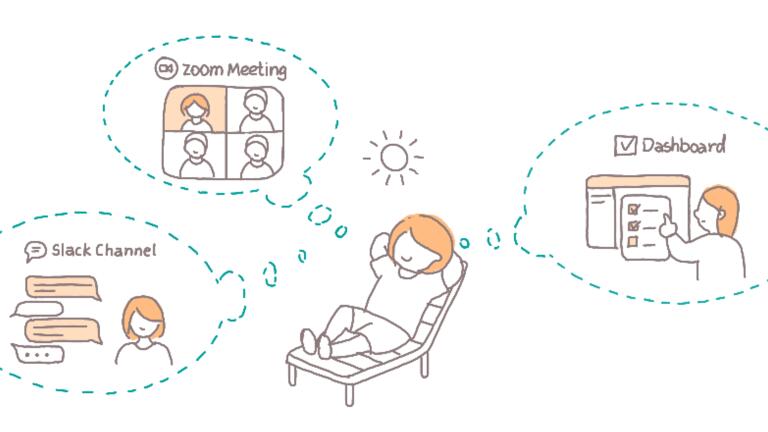
In her first-author paper, “When Your Boss Is an AI Bot: Exploring Opportunities and Risks of Manager Clone Agents in the Future Workplace,” Hu and collaborators investigate an emerging phenomenon: managers creating AI-powered “clone agents” trained on their communication styles and decision-making patterns to act on their behalf.
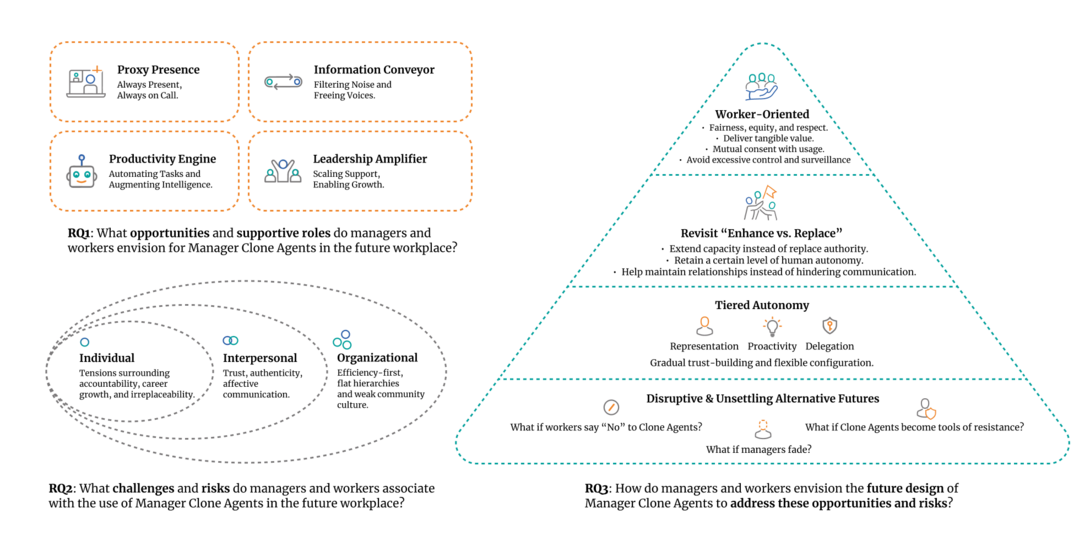
Through six design fiction workshops with managers and workers, the team explored how these "Manager Clone Agents" might function in the workplace. Participants envisioned roles ranging from “proxy presence” and “informational conveyor” to “productivity engine” and “leadership amplifier.” At the same time, they surfaced concerns about trust, authority, interpersonal relationships, and organizational hierarchy.
The study offers design recommendations for integrating such agents responsibly, emphasizing the need to prioritize workers’ perspectives and preserve human connection even as AI systems take on symbolic authority.
For Hu, the project reflects a broader research interest in AI-mediated communication.
“My research interest lies in how we can tap into the intelligence of a machine through conversation and use it to support communication between people,” she explains. “The natural next step is to build and test a real manager clone agent to see how these dynamics actually play out.”
From Individual Tool to Team Infrastructure
In a second CHI paper, “Can GenAI Move from Individual Use to Collaborative Work?” As a research assistant in CARE lab, Hu worked with the Ph.D. student Qing Xiao from HCII on how generative AI is—or isn’t—being integrated into collaborative newsroom environments.
Through 27 interviews with newsroom professionals in China, the team found that while individual journalists frequently use GenAI tools for daily tasks, organizational adoption remains fragmented. Structural barriers and cultural norms often keep AI use private and disconnected from shared workflows.
The research highlights a critical gap between individual productivity and coordinated collaboration, suggesting that making AI work for teams requires rethinking organizational culture and workflow.
The Dark Side of Conversational AI
A third paper, “The Siren Song of LLMs: How Users Perceive and Respond to Dark Patterns in Large Language Models,” shifts focus to ethics and user autonomy.
The study examines how large language models can enact “dark patterns” through conversation, for example, by using exaggerated agreement, biased framing, or subtle privacy intrusions. In a scenario-based study, participants sometimes recognized these manipulative behaviors, but often normalized them as ordinary helpfulness.
The findings raise urgent questions about responsibility, governance, and the role of design in safeguarding user autonomy as conversational AI becomes increasingly embedded in daily life.
Designing at the Frontier
Hu credits the School of Design’s interdisciplinary culture with making this work possible.
“The School of Design makes it really easy to work across departments,” she says. “As a design student, I was able to take courses in other programs at CMU, and that’s actually how these projects started.”
After enrolling in User-Centered Research and Evaluation (UCRE) through the Human-Computer Interaction Institute (HCII), Hu connected with faculty, Dr. Hong Shen who would become a mentor and a research collaborator. At the same time, the hands-on training she received in the Design program—facilitating workshops, building scenarios, and thinking deeply about lived experience—translated directly into rigorous research methods.
“It was really the combination of the cross-department culture at CMU and the hands-on design training that made this possible,” she says.
Looking ahead, Hu plans to continue exploring how AI can mediate and support more meaningful communication, both in the workplace and beyond.
“Advancements in AI-native colleagues have attracted a lot of attention and raised significant concerns about human connection,” she notes. “I want to keep exploring how AI can support more meaningful conversations not replace them.”
For prospective students, her advice is clear:
“You’re not just joining a design program, you’re joining CMU. You can take classes across schools, collaborate with students in CS, business, and beyond. Important interdisciplinary conversations happen here. Innovations happen here, and you’re right in the middle of it.”
With three papers at CHI 2026, Diane Hu is not only at the frontier of those conversations — she is helping shape them.